Wicked: For Good, was given an almost insurmountable challenge from it’s inception: adapt the second act of the stage musical. While the first act, which the first film adapted, contains the most popular songs and is widely considered the resounding highlight, the second act is where it falls short. With notorious sluggishness, plot holes, and pacing issues, the critically panned second act is what caused Wicked to lose the Best New Musical award at the 2004 Tonys to Avenue Q.With the extra time allotted when director Jon M. Chu decided to divide the 2 hour, 45 minute stage play into two films of similar length, the creators of For Good were given the opportunity to flesh out the story and fix the downsides that have plagued Wicked on Broadway. Whether or not Chu succeeded is debatable.
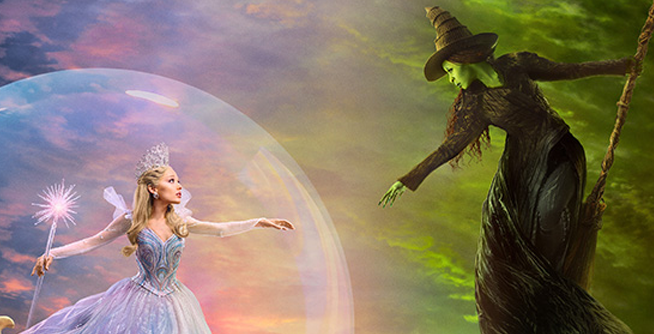
For Good has soaring highs, including another all timer performance from Cynthia Erivo as the Wicked Witch and Ariana Grande as Glinda the Good. The raw talent of Erivo cannot be understated. Her Elphaba was flawlessly executed on screen. Grande triumphs in doing what so many other pop acts couldn’t in transcending the pop star persona into a full blown movie star. With so many other big budget Hollywood productions opting for CGI, it’s incredibly refreshing to see the two films’ fantastical practical sets that fully immerse the viewer into the story. The massive attention to detail and the care put into the film brings the experience of watching the stage musical to the screen in a wholly satisfying way.
However, as expected when adapting the maligned second act of the play, it’s not without it’s downsides. While the acclaimed Oscar winner Michelle Yeoh was a fitting addition to the first Wicked film, mostly attributed to the fact that her character of Madame Morrible didn’t have to deliver a lot of challenging vocals, her performance in For Good was not only weirdly wooden, but her singing capabilities are clearly not up to par with her Broadway contemporaries. Instead of Yeoh’s performance doing the Madame Morrible of the Broadway justice, the creators of For Good were forced to bog down the character by either reducing her presence to talk-singing, or completely cutting her singing parts altogether. With much better suited options, such as standout Broadway Madame Morrible Sheryl Lee Ralph, or the generational talent of Angela Bassett, the casting of Yeoh can’t help but to feel like a horrible misstep on Chu’s part.
For Good also includes two additional numbers added unique to the film, written by the writer of the original music on Broadway, Stephen Schwartz. The first is sung by Erivo, titled “No Place Like Home.” The song is a powerful ballad that Erivo, of course, delivers beautifully. It also shades in more of Elphaba’s character and helps to forward the story in a nuanced way. The insinuation of the song when watching the film does not go unnoticed. The second song added is “The Girl in the Bubble,” sung by Grande. This number is placed after a high tension moment in the third act, and though Grande is a musical talent, the slow pacing of the song and it’s unencessity essentially freezes the plot while her character waltzes around gazing into a mirror. Unlike “No Place Like Home,” Grande’s ballad only reiterates a point previously addressed and simply adds to the film’s bloated runtime that would be better put forward in clarifying plot holes or expanding the story’s tie in with The Wizard of Oz. While Schwartz is able to write genius lyrics, or delightfully corny lyrics that somehow work, the clunky writing of this song reeks of a first draft that wasn’t workshopped or touched upon prior to filming.
While Wicked: For Good is not without it’s flaws, there’s no denying that the two film project does the beloved stage musical justice. With so many other disappointing musical adaptations churned out in the past couple of years, the two Wicked films are proof that when the source material is put into the hands of passionate fans and seasoned professionals, the product is undeniably stronger.